Fiction Writing Demystified by Thomas B Sawyer
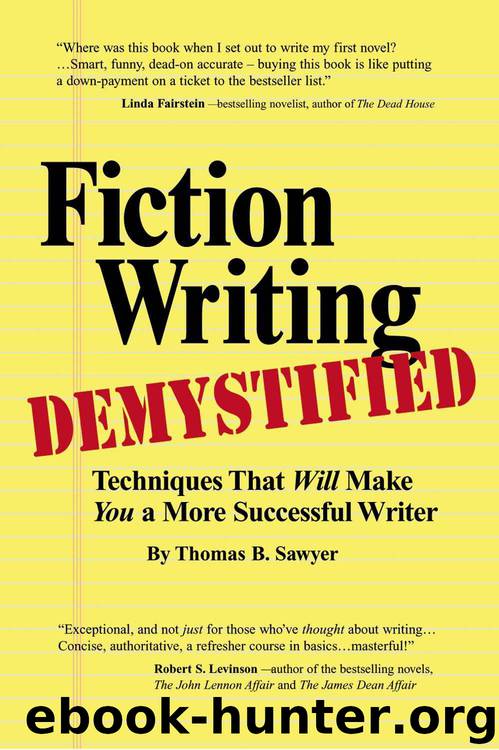
Author:Thomas B Sawyer
Language: eng
Format: mobi
ISBN: 2002110026
Publisher: Ashleywilde Publishers
Published: 2003-04-01T04:00:00+00:00
Attractive Protagonists
In the area of making sure the audience cares about our hero or heroine, about what happens to him or her, a vital question we ask ourselves in TV writing is — will a particular trait or attitude cause the viewer to lose sympathy?
It can be a kind of tightrope-decision: we want the characters we create to have edges, to be provocative, to have those imperfections. And yet they must to be likable enough to hold the audience.
But it’s so easy to go too far in the direction of “selling” our characters, of too-obviously begging for the reader’s or viewer’s affection.
In commercial TV there exists an almost paranoid fear on the part of advertisers and networks of offending even the tiniest portion of the mass-audience. One of the more unfortunate by-products of this dread is a process that takes place in the final stages of readying the teleplay for production. It’s known in the business as “putting the script into the blander.” Part of which is sometimes an actual negotiation between the writer-producer and the network. Frequently this bargaining extends beyond softening character-edges, to the toning-down or removal of onscreen violence and/or sexual content. As ridiculous as it seems, I have occasionally been involved in literal dialogue-tradeoffs on the order of: “Okay, we’ll give you two ‘damn’s’ for one ‘pissedoff.’” Too often the result — one we’ve all seen — is that too many edges are smoothed and rounded off, rendering the content so flat and the characters so excruciatingly ho-hum as to make them downright uninteresting. Unwatchable. The same dynamic sometimes occurs on certain “star-driven” shows, in which the lead-actor wields enough clout to dictate the shadings of the character he or she is portraying — and/or the choice of writers and scripts. This can prove especially detrimental if the actor in question is too worried about “image.”
Eventually, if a writer is lucky, or is enough of a pain-in-theass — or both — he or she may reach a position where the network offers no interference at any stage of a show’s script-development or actual production. Such was my good fortune on a few series, as well as with most of the pilots I wrote.
Not all of the interference comes directly from the networks, but all of it is a straight-line offshoot of the advertisers’ terror. An amusing example: In most TV series, the automobiles used in the show are supplied free of charge by manufacturers who wish to showcase their vehicles. A number of years ago it became the practice on several of the action-series for the villains to drive Mercedes Benzes. A logical choice if you think about it — the brand is both expensive and no-nonsense tough-looking. It said a lot about the villains’ competence.
Well, the executives at Mercedes Benz North America picked up on the trend, and interpreted the statement we were making in a different — and not entirely mistaken light — that it was in effect a kind of negative advertising message.
Download
This site does not store any files on its server. We only index and link to content provided by other sites. Please contact the content providers to delete copyright contents if any and email us, we'll remove relevant links or contents immediately.
Whiskies (Collins Gem) by dominic roskrow(45236)
Spell It Out by David Crystal(36106)
Cecilia; Or, Memoirs of an Heiress — Volume 1 by Fanny Burney(32533)
Cecilia; Or, Memoirs of an Heiress — Volume 2 by Fanny Burney(31931)
Cecilia; Or, Memoirs of an Heiress — Volume 3 by Fanny Burney(31923)
Beautiful Disaster by McGuire Jamie(25310)
Trainspotting by Irvine Welsh(21626)
Chic & Unique Celebration Cakes by Zoe Clark(20051)
The Secret History by Donna Tartt(19012)
How High Can a Kangaroo Hop? by Jackie French(18790)
Twilight of the Idols With the Antichrist and Ecce Homo by Friedrich Nietzsche(18611)
All the Missing Girls by Megan Miranda(15912)
Cat's cradle by Kurt Vonnegut(15316)
Ready Player One by Cline Ernest(14625)
For the Love of Europe by Rick Steves(13840)
Fifty Shades Freed by E L James(13224)
4 3 2 1: A Novel by Paul Auster(12360)
Crooked Kingdom: Book 2 (Six of Crows) by Bardugo Leigh(12298)
Grundlagen Kreatives Schreiben (German Edition) by Helfferich Pia(10433)
